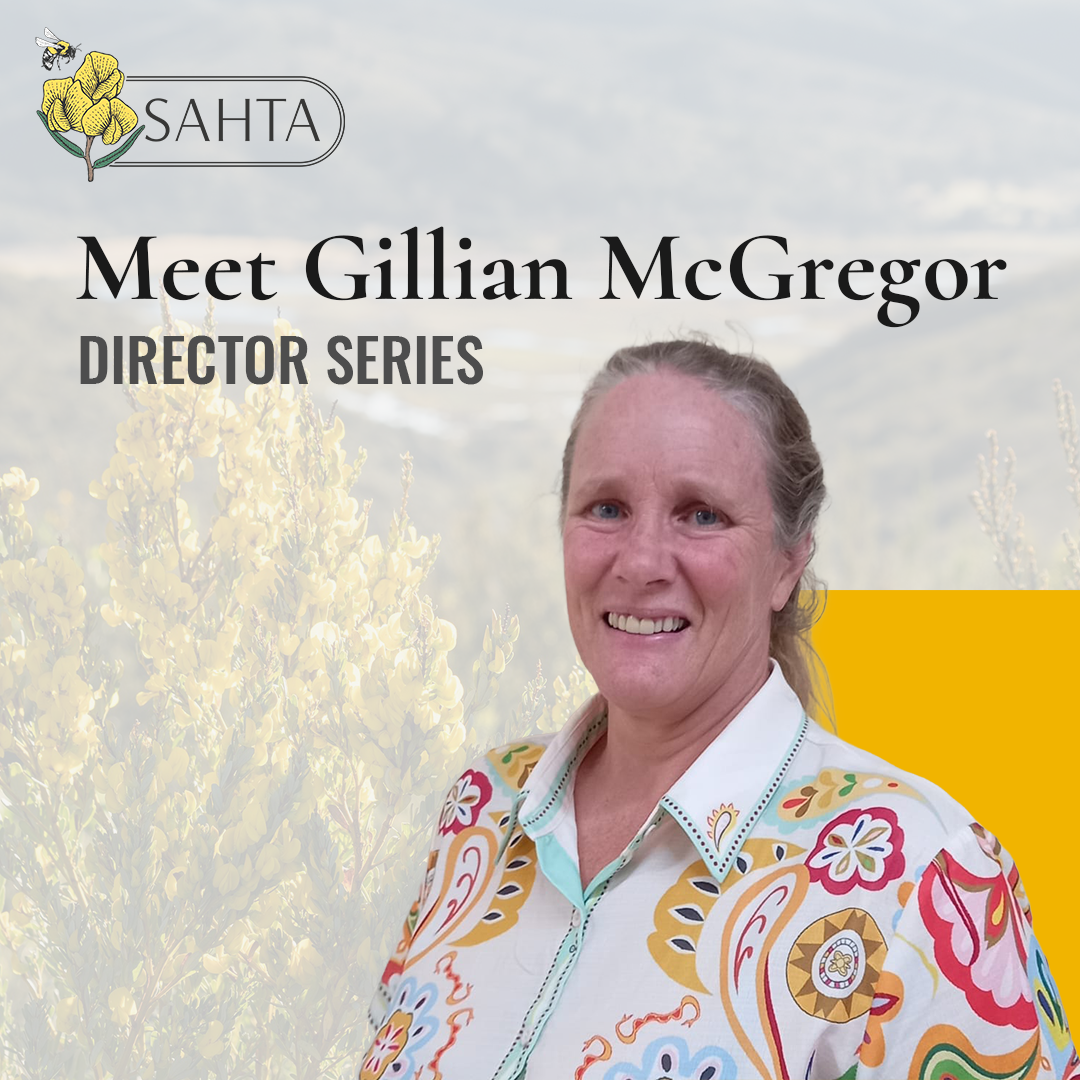
Meet Gillian McGregor, SAHTA Director.
In the green rolling hills of Ixopo, Kwazulu Natal – Gillian grew up on a bee farm, where they produced honey and provided pollination services to high value fruit farms in the Orange Free State. In the cold misty climate, on the slow burning Aga stove in the kitchen – there was always a pot of honeybush tea brewing. The tea came from a farm in the Heidelberg area where Cyclopia sessiliflora was harvested in the wild for tea production. The coarsely chopped stokkies made the most delicious, sweet flavoured, red coloured tea…
About 25 years later: that love of honeybush was re-ignited in a dinner conversation about interesting indigenous South African products. As a geographer (at Rhodes University) she has investigated the social aspects of the industry, the environmental effects of wild-harvesting, as well as economic aspects of Honeybush enterprises and the industry in general. In the process – engaging with the stakeholders from farmers to harvesters and processors to government officials and policy makers. Field surveys took Gillian and her research team deep into the fynbos veld of the Kouga, Tsitsikamma, and Swartberg mountains and beyond, with many days out in the field with harvesters and farmers learning about their trade, recording their tracks and habits. Then adding scientific surveys to the mix: to quantify the effect of harvesting on the plant resource base. The various methods and many sources of data has enabled the compilation of a set of ideas around best practice harvesting of honeybush – informed by the best available knowledge with scientific backing.
She values the combination of local ecological knowledge combined with scientific data in efforts to understand how best to manage wise use of the resource. From a scientific background – her responsibility on the SAHTA board is to provide facts and figures (and maps!) about the industry across various themes, so that information is available to stakeholders and other interested parties. She recognises the potential of the industry to grow the local market sales while keeping up supply of a premium quality, healthy and uniquely South African product on international markets.