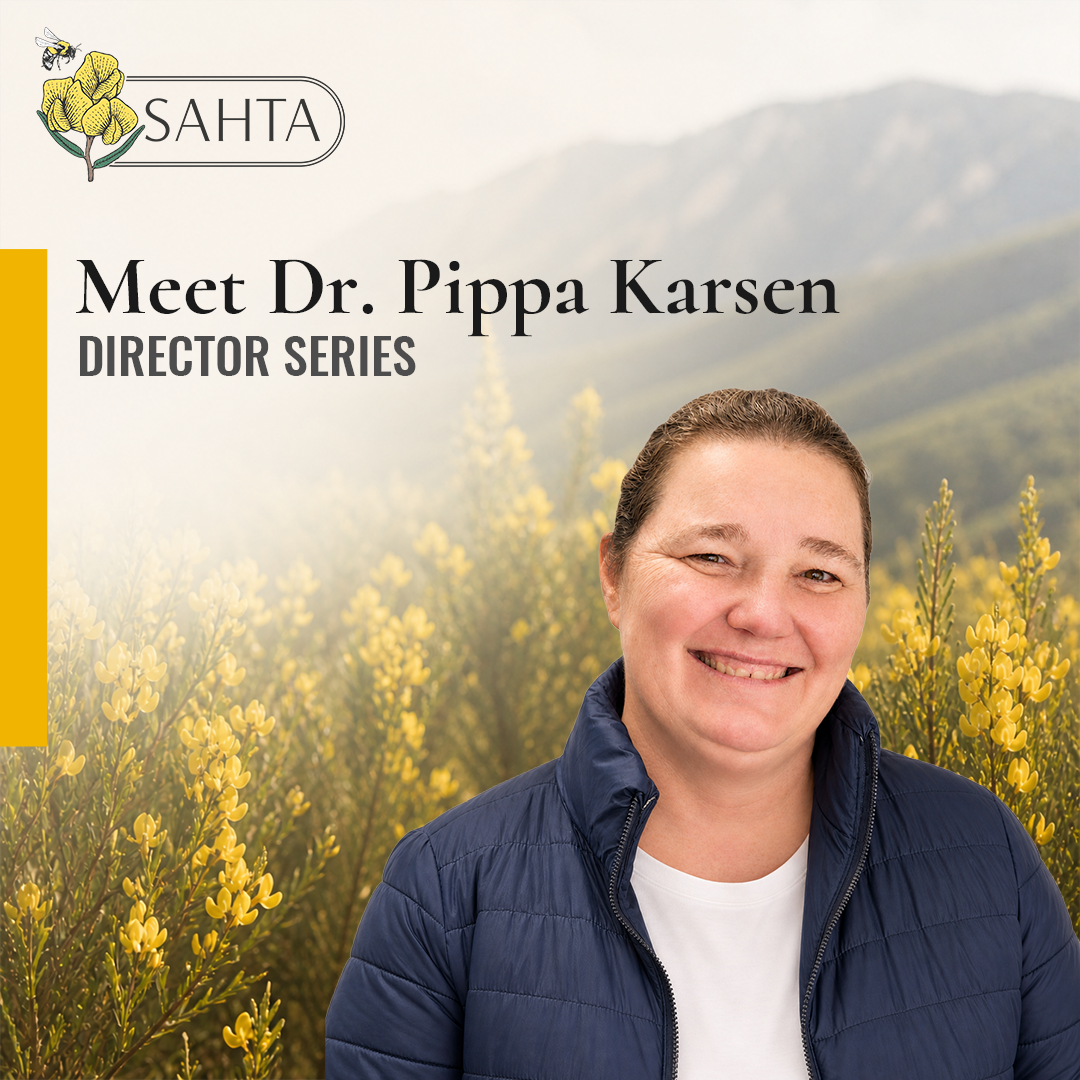
Meet Dr. Pippa Karsen, Director of Research.
Growing up in Cape Town, Pippa Karsen spent much of her childhood on her family’s farm in the Cederberg, where her connection to the natural environment first took root. It was here that her grandmother introduced her to the rich diversity of indigenous plants of the Western Cape, sharing knowledge that would ultimately shape her career. Through time spent in the veld, learning to identify, understand, and appreciate these species, Pippa developed a deep curiosity about how plants function and how they can be sustainably utilised.
That early foundation evolved into a scientific career focused on understanding and unlocking the potential of indigenous crops. As a horticultural scientist with a PhD in Horticultural Science, Pippa has specialised in the propagation, cultivation, and commercial development of species such as Honeybush (Cyclopia spp.). Her work bridges fundamental plant science with practical application, with a strong emphasis on developing systems that are both economically viable and environmentally sustainable.
Through her research, Pippa has engaged extensively with stakeholders across the value chain from farmers and nursery producers to processors, researchers, and policymakers. Her work has included investigating propagation techniques, evaluating the role of biostimulants and rooting media in plant establishment, and contributing to the development of best practices for cultivation. This integrated approach reflects her belief in combining scientific knowledge with practical, field based insights to strengthen the industry.
In her role as Director of Research at South Aftercare Honeybush Tea, Pippa leads research and development initiatives aimed at improving production systems, supporting farmer adoption, and ensuring product quality. She is particularly passionate about translating research into accessible tools and strategies that can support both commercial producers and smallholder farmers.
Pippa values the integration of indigenous knowledge systems with scientific research, recognising that sustainable industry growth depends on both. She is committed to advancing the Honeybush sector as a uniquely South African industry with strong local roots and growing international potential, while ensuring that production remains environmentally responsible and socially inclusive.